Quick Answer
The GTHUNDER (~$57) is the best night vision binocular for most people, and it is also the cheapest here: a 4-inch screen, 10x zoom, and more Amazon ratings than anything else in the category. Pay more only for a specific reason. The VABSCE (~$126) adds a focusable IR beam and a full-color mode that works at dusk. The Vtiisama (~$100) carries the largest battery and includes a memory card, which matters if you are out for hours. If you want genuine optical zoom rather than digital, the WILDGUARDER OWLER1 (~$295) is the only device here that has it, though it is sold direct by the maker rather than on Amazon.
Not sure which binoculars?
Take Our 60-Second QuizSold Direct by the Manufacturer
These two are not on Amazon. They come from WILDGUARDER, a Shenzhen optics maker that sells through its own store, and each earns a place here on one specific spec rather than on overall value. Both cost roughly five times the GTHUNDER above. Buyer feedback is also much thinner: the review counts on the maker's own store are not independent, and there is no Amazon returns window to fall back on. The store runs frequent promotions, so check the current price before you buy.
These are paid affiliate links. We earn a commission if you buy through them, at no extra cost to you.
4Best Optical Zoom
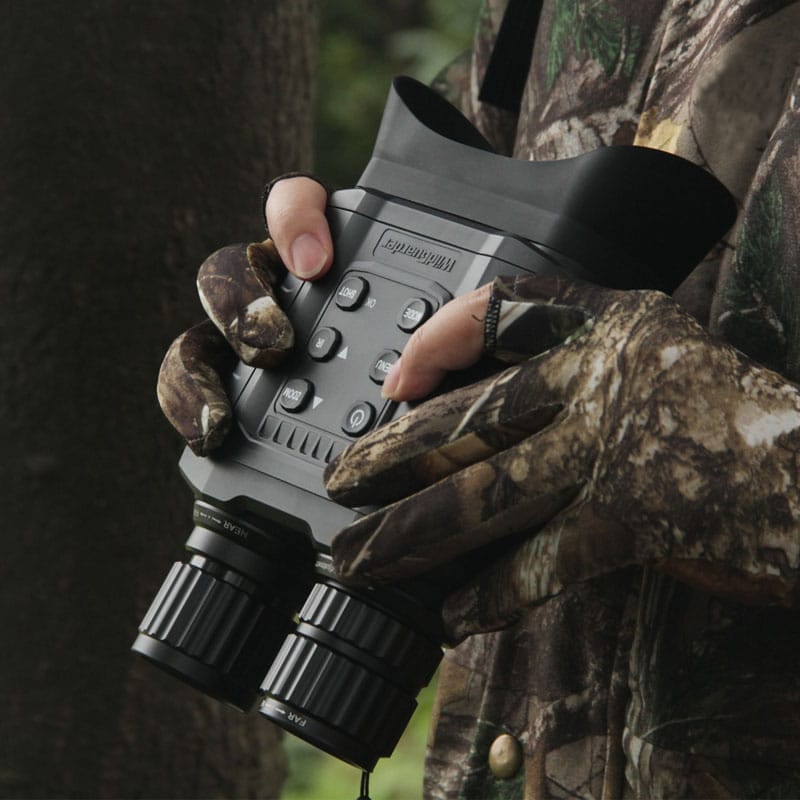
WILDGUARDER OWLER1
WILDGUARDER
8.2/10~$29520× optical / 4× digital · 31.7 oz
The only device on this page with genuine optical zoom. Everything else here competes on digital zoom, which just enlarges pixels — optical zoom actually resolves more detail at distance. That single spec is the reason to consider it, and it is why it sits at roughly five times the price of the GTHUNDER. It is sold direct by the manufacturer, not on Amazon.
Pros- + 20x optical zoom, the only optical zoom on this page
- + 4-inch HD TFT display
- + 5W 850nm IR across 7 adjustable levels
- + 2-year warranty, double the category norm
Cons- - Runs on 8 AA batteries — no rechargeable pack
- - 1080p video, not 4K
- - Sold direct only, so no Amazon returns window
- - 130 reviews on the maker's own store, which is not independent feedback
Digital biocular
5Best Sensor
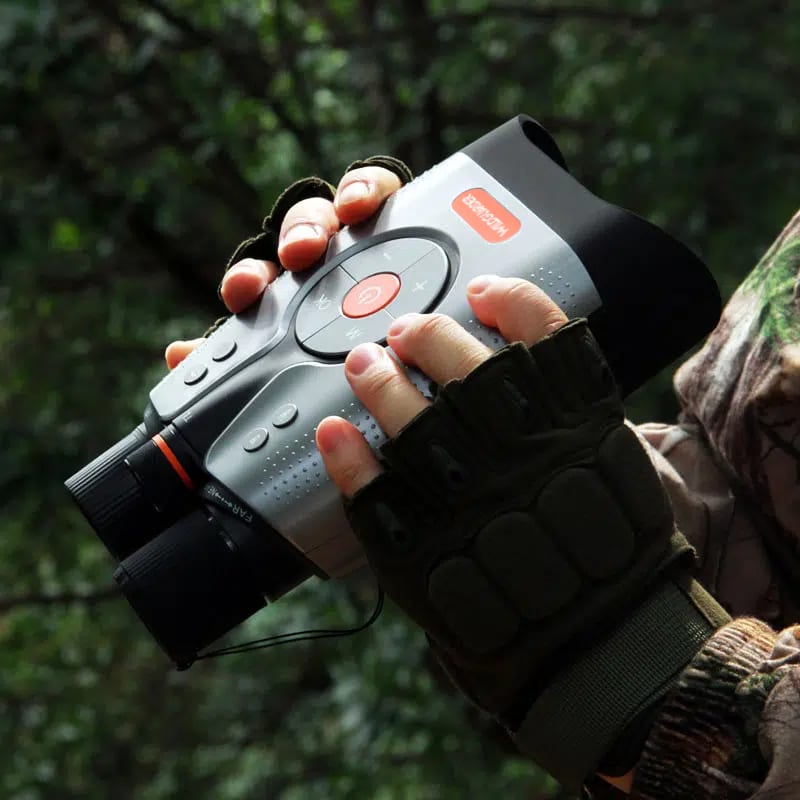
WILDGUARDER Hawknite 1
WILDGUARDER
8.5/10~$3005× optical / 8× digital · 26.5 oz
The only device in this roundup built on a named sensor — Sony's back-illuminated Starvis 2 — which is what separates real 4K from an upscaled still. Add IP67 sealing, USB-C charging and an 18-hour battery, and the spec sheet reads a tier above everything else near $300. It is sold direct by the manufacturer, not on Amazon.
Pros- + Sony Starvis 2 back-illuminated sensor
- + True 4K video at 3840×2160
- + IP67 rated — the only sealed device here
- + 5,100mAh with USB-C and Wi-Fi app control
Cons- - The 1,200m IR claim comes from 3W of emitters — treat it as optimistic
- - Sold direct only, so no Amazon returns window
- - Only 22 reviews on the maker's own store
- - No optical zoom, unlike the OWLER1 alongside it
Digital biocular
The single most useful thing to understand before buying is the difference between optical and digital zoom, because this category advertises both and only one of them adds detail. Optical zoom moves real glass to magnify the scene before it reaches the sensor. Digital zoom crops the image and enlarges the remaining pixels, which makes the subject bigger and blurrier at the same time. Almost every unit in this category offers digital zoom only. The WILDGUARDER OWLER1's 20x optical is the outlier, and it is the reason that device appears here despite a much thinner track record than the Amazon picks.
Digital night vision and thermal imaging solve different problems, and the price gap between them is not a quality ladder. Thermal detects heat, so it finds a warm body through brush, in fog, and against a cold background, but it renders a heat silhouette rather than a picture. Digital night vision amplifies available light and adds infrared illumination, so it shows you an actual image with recognisable detail. The practical division is that thermal finds the animal and night vision identifies it. Thermal units start around $1,300; everything on this page sits between $57 and $300.
Battery format is the spec that quietly determines whether you enjoy owning one of these, and it does not track price the way you would expect. All three Amazon picks on this page ship with rechargeable packs; it is the ~$295 OWLER1 that runs on eight AA cells. Those drain fast with the IR emitter on, and the runtime figures in the marketing assume the IR is off. A rechargeable pack costs nothing to refill and holds a steadier voltage as it depletes, which matters because IR brightness sags as the cells fade. Capacity is the number to compare: the Vtiisama's 5,000mAh is the largest here.
Screen size and resolution deserve more weight than the headline megapixel count. Every device in this category advertises 4K or a high megapixel number, but almost all of those figures are interpolated: the sensor captures less and software scales it up. What you actually experience is the internal display, which is typically 3 to 4 inches at 854x480. A larger, sharper screen makes a bigger difference to how usable the device feels at night than any number on the box, and screen size does not track price here: the $57 GTHUNDER and the $295 OWLER1 both use 4-inch panels, while the $100 Vtiisama uses a 3-inch one. The one place a sensor claim is worth taking seriously is when a manufacturer names the part, as WILDGUARDER does with the Sony Starvis 2 in the Hawknite 1.
Night hunting law varies sharply by state and is worth checking before you buy. Texas, Oklahoma and several other states permit night hunting of hogs and predators with artificial light or night vision, while California, New York and Massachusetts restrict or prohibit it. Rules also differ by species, by season, and sometimes by county, and permit requirements change more often than gear does. Confirm the current regulations with your state wildlife agency rather than relying on a product listing.
Frequently Asked Questions
- Are night vision binoculars actually binoculars?
- Usually not. Most digital night vision devices under $400 have a single objective lens, one sensor, and one internal screen viewed through two eyecups. The correct term is a biocular. You see the same flat image with both eyes, which means no stereo depth perception, so distances are harder to judge than through true binoculars.
- What is the difference between night vision and thermal imaging?
- Thermal detects heat and works through brush, fog and total darkness, but shows a heat silhouette rather than a recognisable picture. Digital night vision amplifies available light plus infrared and shows an actual image with detail you can identify. In short: thermal finds the animal, night vision identifies it. Thermal units start around $1,300 versus $57 to $300 for digital night vision.
- How far can night vision binoculars really see?
- Less far than the box says. Advertised IR range is measured in ideal conditions against a large reflective target, and real-world range is commonly well short of it. Emitter wattage is the honest signal: a 5W emitter genuinely reaches further than a 3W one, regardless of the metre figure printed on either package. Treat long-range claims from low-wattage emitters with particular caution.
- How much should I spend on night vision binoculars?
- Less than you would think. Around $60 already buys a 4-inch screen, 10x zoom and a rechargeable pack, which is why the cheapest pick on this page is also the top one. Paying $100 to $130 buys a specific capability rather than a general upgrade: a bigger battery, or a focusable IR beam and a full-color mode. Only above roughly $250 do you reach genuine optical zoom, named sensors and weather sealing, and those matter only if you have a concrete reason to need them.
- Does 4K mean anything on a night vision device?
- Rarely. Most 4K and high-megapixel claims in this category are interpolated, meaning the sensor captures less and software scales the result up. The figure worth trusting is a named sensor part, such as the Sony Starvis 2 in the WILDGUARDER Hawknite 1. When no sensor is named, judge the device on screen quality and IR emitter wattage instead.
- Can I use night vision binoculars during the day?
- Yes, with the IR emitter switched off. Digital night vision devices use a standard CMOS sensor, so they work as ordinary daytime cameras, though image quality falls short of a dedicated camera or real optical binoculars. Never point one at the sun. If you want a single device for daylight glassing, buy optical binoculars instead.